

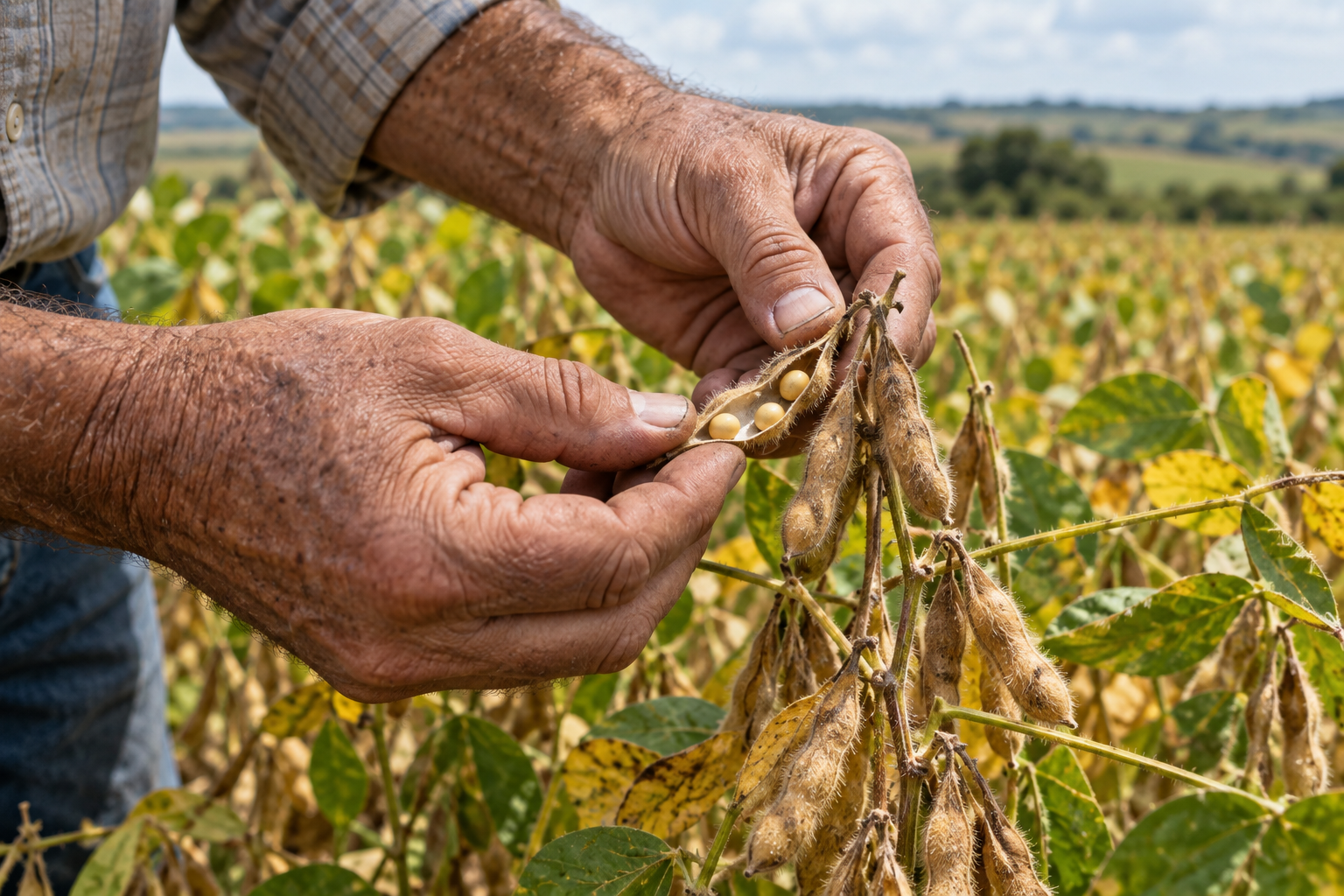
When grain comes together in a silo, can you still distinguish its history?
Storage requires attention to moisture, impurities, and preservation. Traceability adds another layer: knowing which deliveries make up the stock being shipped. A receiving record documents an arrival; on its own, it cannot reconstruct every origin in a mixture.
Technical context: Embrapa Soja — grain quality in storage (opens in a new tab).
The supply chain journey
- Field and crop season
- Receiving
- Storage
- Dispatch
Illustrative journey: the actual organization varies by operation.
What to organize in practice
A starting point for a conversation with your technical team:
- Connect every delivery to its field, crop season, and producer.
- Check receiving records, weights, invoices, and warehouse identification.
- Record which incoming deliveries make up each shipment, including mixtures.
- Make unknown origins and unconfirmed connections explicit.
An everyday situation
A cooperative combines deliveries from three farms. The outgoing lot needs to retain its connection to all three deliveries, not just the cooperative’s business registration number.
An important distinction
Physical segregation and recordkeeping complement each other. A volume balance does not, by itself, identify the origin of every portion of the stock.
How this connects to Trace
Use farm records, supplier and lot relationships, and documents to organize what your operation can demonstrate. Record the gaps too: declared information and verified evidence are not the same thing.
Explore the features and their limitsTraceability questions for this supply chain
How can soy traceability be organized when grain is mixed in a silo?
Connect incoming deliveries to stock and shipments, retaining links to producers, fields, and crop seasons. If those links have been lost, record the gap: an outgoing invoice cannot recover an unknown origin.
Are physical segregation and volume control the same thing?
No. Physically separating materials is different from reconciling inputs and outputs. When preparing EUDR information, describe the method actually used and the origins it can demonstrate. Do not present an accounting balance alone as complete traceability.
Organizational guidance. Technical and legal assessment depends on the operation and available evidence.